The apple picking season is over, but my favorite orchard still has a whole harvest for sale out of their storage. I can't stop buying Northern Spy, Wealthy and Empire apples. Northern Spy and Wealthy are amazing to cook with. Pies, apple butter, crisps and crumbles keep marching out of my kitchen and the flavor of these apples really shines.
Northern Spy is an accidental seedling discovered in the early 1800's in either New York State or Connecticut, and one of its parents is Wagener. Wherever it came from, it is an excellent culinary apple and not too shabby to eat out of hand! The trees can take up to ten years to bear, so I am grateful for my local orchard for their foresight and love of pies.
I planted a Wealthy apple tree on our property two years ago, and we will probably be getting fruit in two years. Bred in Minnesota in the 1800's from a crab apple, it is cold hardy, disease resistant, and yummy. They keep all winter and are sweet, tart and addictive. The texture is like a firm McIntosh, good for pies, eating and even cider.
The Empire apple is a cross between red delicious and McIntosh apples. I don't really care for either of its parents, but I can't stop eating Empire apples. They are crisp and flavorful and are so dark red they almost look black. Snow White would have taken a bigger bite of this apple. Eve would have eaten the whole thing and gone back for another. Atalanta would have thrown a dozen races. I love these apples and eat about three a day.
Sunday, November 7, 2010

Monday, November 1, 2010


Wednesday, October 20, 2010
The Moon
The Moon is rising over the cemetery next door and shining in our windows through the cedar. Saturday is the actual full moon, but it is terribly bright tonight. It makes a monochromatic lace of tree, clouds and light. The kind of night to sit outside, with something warm to drink, and watch it rise and set.
Sunday, October 17, 2010

Thursday, September 23, 2010


Friday, September 17, 2010
nervous
Tomorrow I am joining a group of women selling knit goods at the farmer's market. I am very nervous. Pictures coming soon
Monday, September 13, 2010
Fungus among us
The super dry summer was hard on the garden. It stressed the plants and made them susceptible to all sorts of diseases. The cucumbers and the summer squash were both hit pretty hard with powdery mildew. The cukes kept producing up to the bitter end, but they were kind of funny looking.
To prevent the mildew from coming back next year, I yanked all the plants out and bagged them for the dump. If they were composted, the spores would have been put back into the garden next year and the cycle would repeat.
I have read that corn meal added to the soil encourages the growth of a harmless fungus that crowds out powdery mildew and other nasty bugs. or maybe the corn meal feeds a fungus that will eventually feed on other fungi. something like that. So I added a cup or two of corn meal and some compost and planted about 36 cloves of garlic. Next week is my seasonal manure pickup, and I will mulch give it a generous mulching of manure and peat. and maybe some limestone if my soil tests come back saying the dirt is too sour.
you'll have to excuse my rambling post. I have a new job and between getting Miss Critterpants to daycare and the drive, I have to wake up a little bit before 5am. It's a difficult schedule for my lazy stay-at-home-Mom ways.
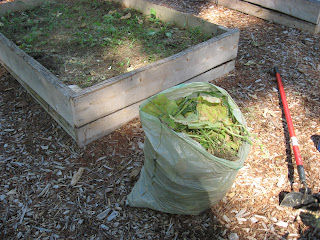
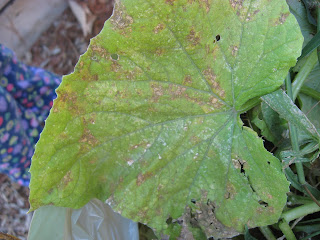
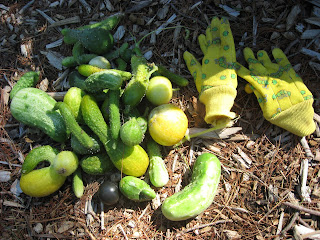


To prevent the mildew from coming back next year, I yanked all the plants out and bagged them for the dump. If they were composted, the spores would have been put back into the garden next year and the cycle would repeat.
I have read that corn meal added to the soil encourages the growth of a harmless fungus that crowds out powdery mildew and other nasty bugs. or maybe the corn meal feeds a fungus that will eventually feed on other fungi. something like that. So I added a cup or two of corn meal and some compost and planted about 36 cloves of garlic. Next week is my seasonal manure pickup, and I will mulch give it a generous mulching of manure and peat. and maybe some limestone if my soil tests come back saying the dirt is too sour.
you'll have to excuse my rambling post. I have a new job and between getting Miss Critterpants to daycare and the drive, I have to wake up a little bit before 5am. It's a difficult schedule for my lazy stay-at-home-Mom ways.


Saturday, September 11, 2010
Today
Today is nine years since I walked to Queens from 17th and 5th. I will always be thankful for the company I had that day and the kindness of a friend who had volunteered to let us stay with him.
Sunday, September 5, 2010
Sweet Cherry Demise
My Black Gold sweet cherry is dying a slow and horrible death from THE CANKER. Canker is a bacterial infection in the bark that can be pruned out and the tree survive, if the disease is in a twig or branch. However, my tree is the Mimi of the garden and is dying in a big dramatic opus of oozy sap and an infected trunk. koff koff hack hack big finishing aria and dead. I will be surprised if she makes it through the winter.
A piece of advice that I have taken is to always plant disease resistant trees because they are such an investment of time and money, and Black Gold cherry from Starks is not an exception. I do think because it is a Zone 5 tree, instead of my preferred Zone 4, it suffered winter bark damage which made it susceptible to Canker.
sigh.
So I spent many hours researching sweet cherries that were not only disease resistant, but hardy to zone 4 and happy on the east coast.
My results are as follows:
Kristen - zone 4, very winter hardy, good to moderate crack resistance (where the cherries split, not the cocaine-based drug. either way, it's good) It's an early season bearer and the fruit is moderately sized and firm, dark red. - my concerns are that it is an early season fruit, which usually means it blooms earlier in the spring and we can have frosts all the way to the end of May.
White Gold - zone 4b, well adapted to the North East, low susceptibility to cherry leaf spot and bacterial canker (CANKER!), self-fertile, mid to late season bloom. The fruit is light yellow and has a good flavor. - my concerns are, well there really aren't any. it's hardier than any other cherry, specifically resistant to the disease we have here and it pollinates itself! but it's yellow. and I kind of love red cherries. It's a stupid reason not to choose what would otherwise be considered a perfect tree, but still...
Sylvia - zone 4, good bacterial canker tolerance, cracking resistance varies widely, late season bloomer and the fruit is dark red, large and firm. It sounds great! Except it needs another late season bloomer to pollinate it. So there would have to be another hold hardy, late season disease resistant sweet cherry nearby
Hudson - zone 5, bred in the Hudson River Valley in NY, it is listed as very good winter tolerance, canker and crack resistant, late season bloomer, fruit is large, firm and mahogany red. it's zone 5! how winter resistant could it be? but if it could survive here, it would be a perfect pollinator for Sylvia. Sylvia and Hudson would make such a handsome sounding couple, but I may only have room for one tree.
On top of choosing a new tree, there will have to be a new planting site, because the bacteria can harbor in the soil. So, if I am choosing a new site on our property, maybe I can plant TWO sweet cherry trees! Sylvia and Hudson could be together with their branches lovingly entangled , and I would cover them with bird netting to give them privacy from those nosey crows that tend to hang about.
A piece of advice that I have taken is to always plant disease resistant trees because they are such an investment of time and money, and Black Gold cherry from Starks is not an exception. I do think because it is a Zone 5 tree, instead of my preferred Zone 4, it suffered winter bark damage which made it susceptible to Canker.
sigh.
So I spent many hours researching sweet cherries that were not only disease resistant, but hardy to zone 4 and happy on the east coast.
My results are as follows:
Kristen - zone 4, very winter hardy, good to moderate crack resistance (where the cherries split, not the cocaine-based drug. either way, it's good) It's an early season bearer and the fruit is moderately sized and firm, dark red. - my concerns are that it is an early season fruit, which usually means it blooms earlier in the spring and we can have frosts all the way to the end of May.
White Gold - zone 4b, well adapted to the North East, low susceptibility to cherry leaf spot and bacterial canker (CANKER!), self-fertile, mid to late season bloom. The fruit is light yellow and has a good flavor. - my concerns are, well there really aren't any. it's hardier than any other cherry, specifically resistant to the disease we have here and it pollinates itself! but it's yellow. and I kind of love red cherries. It's a stupid reason not to choose what would otherwise be considered a perfect tree, but still...
Sylvia - zone 4, good bacterial canker tolerance, cracking resistance varies widely, late season bloomer and the fruit is dark red, large and firm. It sounds great! Except it needs another late season bloomer to pollinate it. So there would have to be another hold hardy, late season disease resistant sweet cherry nearby
Hudson - zone 5, bred in the Hudson River Valley in NY, it is listed as very good winter tolerance, canker and crack resistant, late season bloomer, fruit is large, firm and mahogany red. it's zone 5! how winter resistant could it be? but if it could survive here, it would be a perfect pollinator for Sylvia. Sylvia and Hudson would make such a handsome sounding couple, but I may only have room for one tree.
On top of choosing a new tree, there will have to be a new planting site, because the bacteria can harbor in the soil. So, if I am choosing a new site on our property, maybe I can plant TWO sweet cherry trees! Sylvia and Hudson could be together with their branches lovingly entangled , and I would cover them with bird netting to give them privacy from those nosey crows that tend to hang about.
Saturday, September 4, 2010
Citrus
Even though I am having difficulty keeping my cherries and apples alive and disease free, I am having wild imaginings of a greenhouse in which to keep a collection of rare and unusual citrus trees.
The trees that i have found are hardy (for brief periods) down to 10 degrees
Chinnotto Orange: an Italian orange tree, important in its country of origin for candy, marmalade and soda. Bitter orange. Self-fertile
Juanita Tangerine: named after the South Carolina woman who planted a grocery store pip and grew a tree that withstood 10 degree temperatures when ever other citrus around it died died died. It is tender and sweet and excellent eating quality.
Yuzu Lemon: a traditional Japanese citrus tree/shrub that is rare in the US. It has a complex grapefruit/lime/mandarin flavor and the zest is used in Japanese cooking and apparently the juice makes a really good cocktail. On the winter solstice in Japan, it it traditional to float the fruit in a hot bath to ensure health during the cold months (or so i have read on the internets). The fruit stores well in a cool dry place.
Bloomsweet Grapefruit: hardy to 10 degrees. A 15 foot tall tree that bears prolifically. Large and delicious fruit
The trees that i have found are hardy (for brief periods) down to 10 degrees
Chinnotto Orange: an Italian orange tree, important in its country of origin for candy, marmalade and soda. Bitter orange. Self-fertile
Juanita Tangerine: named after the South Carolina woman who planted a grocery store pip and grew a tree that withstood 10 degree temperatures when ever other citrus around it died died died. It is tender and sweet and excellent eating quality.
Yuzu Lemon: a traditional Japanese citrus tree/shrub that is rare in the US. It has a complex grapefruit/lime/mandarin flavor and the zest is used in Japanese cooking and apparently the juice makes a really good cocktail. On the winter solstice in Japan, it it traditional to float the fruit in a hot bath to ensure health during the cold months (or so i have read on the internets). The fruit stores well in a cool dry place.
Bloomsweet Grapefruit: hardy to 10 degrees. A 15 foot tall tree that bears prolifically. Large and delicious fruit
Subscribe to:
Posts (Atom)
